
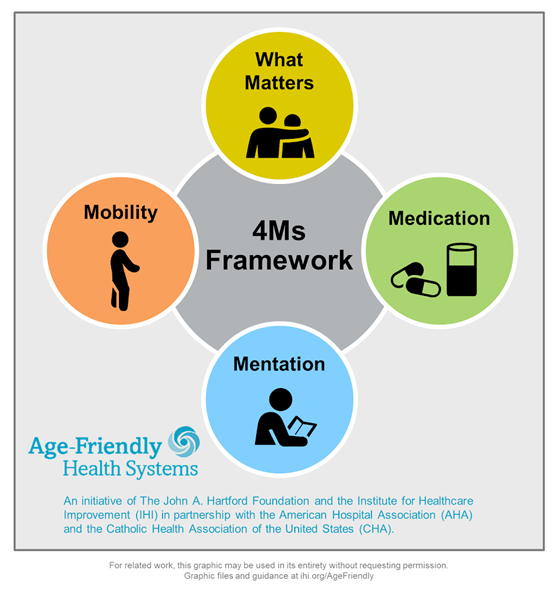
Age friendly Healthcare
What matters –
Know and align care with each older adult’s specific health outcome goals and care preferences including, but not limited to, end of life care and across settings of care.
Medications –
If medication is necessary, use age friendly medication that does not interfere with what matters to the older adult, mobility, or mentation across settings of care.
Mentation –
Prevent, identify, treat, and manage dementia, depression and delirium across settings of care.
Mobility –
Ensure that all the adults move safely every day in order to maintain function and do what matters.
Upstream view to the problem solving
There is a well-known public health parable about the “upstream thinking approach”. That goes like this:
Two friends named Ramu and Damu are by a river when they see a child is coming down the stream and drowning. Damu dives in and saves the child. But then another struggling child comes along, and another. Damu can hardly keep up with the crisis. Damu looks around for Ramu when he notices Ramu is running upwards on the riverbank.
Ramu notices there are multiple children on a broken bridge falling into the river. He reinforces the bridge and saves them all.
Now let’s understand with an example in healthcare.
‘Upstreamist’ approach in simple terms means, ‘How to solve a problem before it arises or in early stages prior to worsening’.

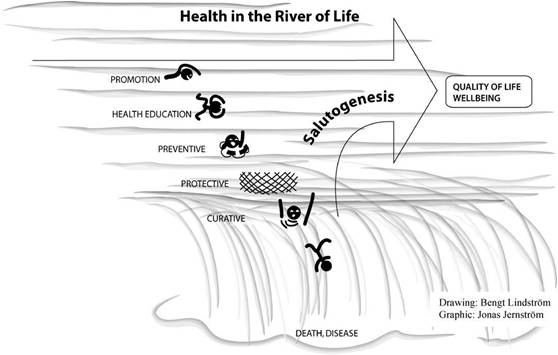
An approach to healthcare that examines, and addresses root causes rather than symptoms of diseases. This helps to improve long-term outcomes and decrease healthcare costs.
Importance of this approach was very apparent to us when we saw a 66 year old female named Shantabai. After her husband’s death, she was grasped with depression and consequently became sedentary and had started stress eating. It was difficult for her to talk about it to anyone. She put on a lot of weight. She then started complaining of knee pain and fatigue and lack of energy. Unfortunately, that local doctor prescribed her pain killers (non-steroidal anti-inflammatory medicines) over a long period of time with steroid bursts quite often.
Her fatigue was most likely due to severe obstructive sleep apnea which was secondary to her morbid obesity. This went on without proper evaluation and as a repercussion to that she developed kidney failure and heart failure. She had spent multiple days shuttling from hospital to home (downstream approach).With an upstream approach there was strong possibility to have to define and diagnose her initial healthcare issues i.e. major depression, sedentary lifestyle, poor dietary habits and family dynamics, inappropriate use of medications etc to be able to stop the downward spiral towards life threatening complications.
At Rekindle Healthcare our team is trained and focused on finding the root cause of the problem for individual patients. We, in our efforts towards an upstream approach to healthcare for our patient’s, strive to promote healthy environment and habits, disseminate health education, collaborate with community health programs, and involve in policy development at local and broader scale.
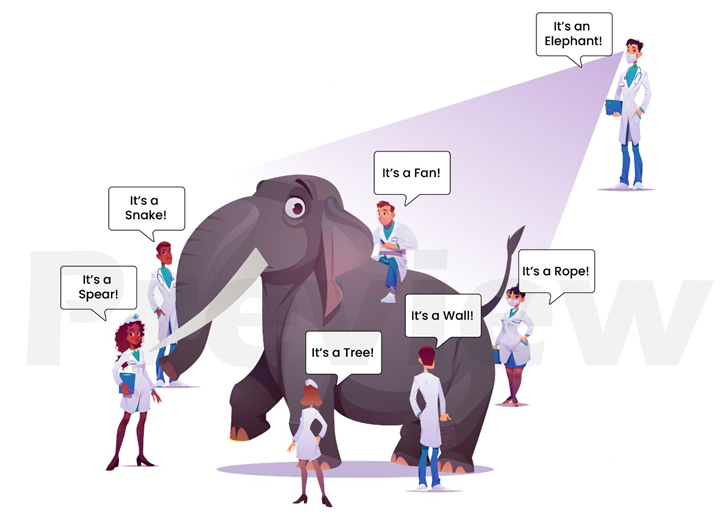
Time to change “the blind men and the elephant” approach in healthcare to care for older adults.
There is an ancient fable that has been told and retold across many centuries and in many cultures, known as “the six blind men and the elephant”.
There were six brilliant but blind men who encountered an elephant for the first time.
The first blind man touches the side of the elephant and describes the elephant like a wall. The second one touches the tusk and calls it a spear. The third one touches the trunk and describes it as a snake. The fourth one touches the knee and calls it a tree. The fifth one touches the ear and says it’s a fan. Finally, the last one touches the tail and describes the elephant as a Rope!
None of them called an Elephant an Elephant. Do you know why? Because each man only focused on the part of the elephant they touched. You must put all the parts together to find out what an elephant is like.
A common interpretation of the story is that; without the big picture, one can easily come to a false conclusion.
Let’s see how this relates to the current healthcare system of a complex or elderly patient.
Consider an elderly or a complex patient as the elephant. When you are taking care of a complex elderly person who has multiple medical, social, and emotional issues, you must look at the whole person. However, as we commonly notice, the current health system heavily tilted towards individual specialty care tends to deal with one organ system only and not pay attention to other organs or problems or medicines and their interactions.
Geriatric medicine specialists are experts in seeing the big picture, the whole patient (an elephant), instead of just focusing on individual organs (like blind men did).
At Rekindle Healthcare geriatric medicine specialists are trained in managing older adults from primary care to critical care setting to end of life care. We care and value the whole person.